
Ultimate Guide to Exploring the Angkor Archaeological Park

The first time you see the silhouette of towers rising above the jungle canopy, something shifts. Angkor Wat is not just a monument. It is not just history. It is the feeling that human beings, centuries ago, poured every ounce of their devotion, ambition, and artistry into a stone, and somehow that stone is still standing, still speaking.
If you have been wondering where to begin, or simply where Angkor Wat temple is exactly, this guide will walk you through everything, including how the circuit system works, what to expect, and why this place deserves more than a single rushed morning.
Where Is Angkor Wat Temple and Angkor Archaeological Park?
The Angkor Wat temple in Cambodia sits near the town of Siem Reap, in the northwestern part of the country. Siem Reap itself is a charming, well-connected town that has grown almost entirely around the existence of these temples. Fly in, step out, and within 20 minutes you are at the entrance gates.
The broader Angkor Archaeological Park sprawls across roughly 400 square kilometres of forest, farmland, and ancient waterways, making it the largest religious complex ever constructed by humankind. A UNESCO World Heritage Site since 1992, it draws over two million visitors a year, and yet, if you time it right, you can still find corners of it entirely to yourself.
Who Built Angkor Wat Temple?
Angkor Wat was built by the Khmer King Suryavarman II in the early 12th century, somewhere between 1113 and 1150 CE. He dedicated it to the Hindu god Vishnu, which made it unusual for the region at a time when many Khmer rulers favoured Shaivism. The architectural precision involved is staggering. The temple is aligned to face west, toward the setting sun, a direction associated with both Vishnu and, notably, with death and the afterlife in Khmer tradition.
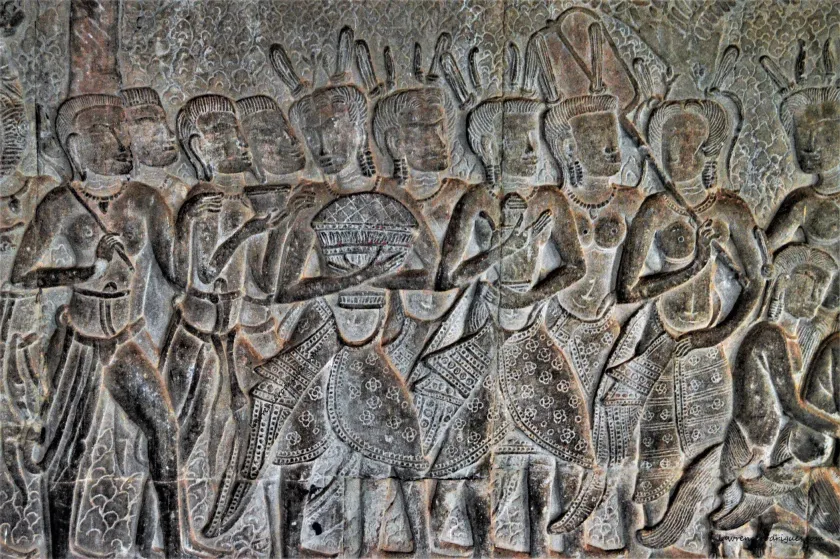
Who built Angkor Wat temple is a question with a layered answer. Suryavarman II commissioned it, yes, but the real builders were thousands of ordinary workers, architects, sculptors, and engineers whose names we will never know. They carved over half a kilometre of continuous bas-relief galleries depicting cosmic battles, royal processions, and scenes from Hindu epics. That kind of scale comes from generations of belief.
After Suryavarman II, subsequent rulers expanded the broader Angkor complex. King Jayavarman VII, perhaps the most prolific builder in Khmer history, constructed the walled city of Angkor Thom and the enigmatic Bayon temple with its dozens of stone faces gazing inquisitively in every direction. The complex is not the work of one era. It is a layered city of stone that grew over four centuries.

Understanding the Angkor Circuits
This is where most first-time visitors get a little overwhelmed, and understandably so. The Angkor Archaeological Park is not one temple. It is an entire landscape of temples, and navigating it well makes all the difference between a meaningful visit and a forgettable one.
The park is divided into two primary circuits, each designed to group temples by proximity and significance. Think of them less as rigid tourist routes and more as a sensible way to stop yourself from criss-crossing the jungle in 38-degree heat without a plan.
The Small Circuit (Petit Circuit)
The Small Circuit is roughly 17 kilometres long and covers the most iconic sites. Most visitors dedicate their first full day to this loop, and it earns every hour you give it.
It begins, naturally, with Angkor Wat itself. Give this temple the morning. Walk the outer gallery slowly. The bas-reliefs here stretch for nearly 800 metres and tell the story of the Churning of the Ocean of Milk, scenes from the Mahabharata and Ramayana, and the 37 heavens and 32 hells of Khmer cosmology. The stone colonnettes of windows in Angkor Wat have distinctive ringed columns that cast the shadow depicting Angkor Wat when the first rays of sun hits them. It's truly mind-blowing to feel these intricacies and most people end up being oblivious to it.


From there, the circuit takes you through the South Gate of Angkor Thom, a dramatic causeway flanked by 54 gods on one side and 54 demons on the other, all pulling a giant naga serpent. Even the entrance here is storytelling. Inside the walled city of Angkor Thom, Bayon waits at the centre. This is the “Temple of the Faces”. Over 200 enormous stone visages, believed to depict either the Bodhisattva Avalokitesvara or King Jayavarman VII himself, stare outward from every tower. Walking among them in the low morning light is quietly phantasmagoric in the best possible way.

Baphuon, just northwest of Bayon, is a temple-mountain dedicated to Shiva and one of the more under-rated stops on the circuit. Its long elevated walkway stretches over 200 metres and is worth the walk alone. Behind the main sanctuary, a massive reclining Buddha carved into the western gopura is easy to miss if you are not looking for it.

The Terrace of the Elephants and the Terrace of the Leper King are open-air platforms used for royal ceremonies and public audiences. They are not enclosed temples but rather grand civic structures lined with intricate carvings of elephants, garudas, and nagas. Standing on the Terrace of the Elephants, looking out across the vast square where armies once assembled, you get a sense of the sheer scale of Khmer statecraft.

The Small Circuit ends at Ta Prohm, and it saves its most theatrical moment for last. This is the temple the jungle never fully gave back. Silk-cotton and strangler fig trees have grown over and through the structure over centuries, their roots snaking through doorways and splitting stone towers apart. It looks, genuinely, like a film set, which is partly why it was used as one (Lara Croft: Tomb Raider was filmed here). But underneath the cinematic drama is something more quietly affecting: the sense that nature has its own timeline, and stone, for all its permanence, is just another thing that eventually yields.
The Grand Circuit (Grand Circuit)
The Grand Circuit extends the loop to approximately 26 kilometres and ventures further into the park's quieter, less-visited corners. This is the circuit for your second day, when the initial overwhelm has settled and you are ready to simply wander and absorb.
Preah Khan is the highlight here, and arguably one of the most rewarding temples in the entire complex. Built by Jayavarman VII in the late 12th century and dedicated to his father, it was not just a temple but a functioning monastic city with thousands of teachers, dancers, and support staff. Today it is a sprawling, partially unrestored labyrinth of corridors, shrines, and crumbling galleries, with enormous trees pushing through the roofline. Unlike the more manicured experience at Angkor Wat, Preah Khan feels raw and exploratory. Go early, go slow, and let yourself get a little lost.

Neak Pean is one of the more unusual stops, and one that requires a short walk across a raised wooden walkway over a seasonal lake. At its centre sits a small circular island temple built around an artificial pond, with four smaller pools radiating outward in cardinal directions. It was originally a place of healing, where pilgrims would bathe to cure illness. Today the site has a quiet, contemplative quality that feels different from the grandeur of the larger temples.

Ta Som is small enough to explore in 30 minutes, but it punches above its weight visually. Its eastern gopura, a stone gate tower, has been almost entirely consumed by a massive fig tree, creating a natural frame of roots and stone that is one of the most photographed spots in the outer circuit. The temple is rarely crowded, and its compact size means you can truly examine every carving at close range.

Eastern Mebon and Pre Rup round out the Grand Circuit. Both are temple-mountains from the 10th century, built before Angkor Wat, and both offer elevated platforms with wide views across the surrounding landscape. Pre Rup, in particular, is a popular sunset spot, though fewer people know about it compared to the main temple, which means you are more likely to watch the light change with room to breathe.

Beyond the Two Circuits: The Outer Temples
Beyond the two main circuits, there are outer temples like Banteay Srei, a smaller temple carved in pink sandstone with such intricate detail it has been called the jewel of Khmer art. It sits about 25 kilometres from the main complex but is absolutely worth the extra travel time. The carvings here, depicting scenes from Hindu mythology, are so fine they are thought by some historians to have been made by master craftsmen rather than the standard temple workforce. Seeing it on the same day as the larger temples risks numbing the impact. Better to save it for a standalone morning.
Beng Mealea, roughly 68 kilometres east of Siem Reap, is for those who want to see what Angkor might have looked like before restoration and tourism arrived. Almost entirely unrestored, it is a glorious, crumbling ruin reclaimed by jungle, with wooden walkways guiding you over and around collapsed galleries and enormous tree roots. Very few visitors make it this far. Those who do tend to remember it as the most atmospheric stop of their entire trip.
Practical Notes Worth Knowing
Angkor Wat temple area requires a pass, available in one-day, three-day, and seven-day formats. Three days is the sweet spot for most travellers who want to genuinely absorb the place rather than just tick it off a list.
Sunrise at Angkor Wat is deservedly famous. The reflection of the towers in the front pond turns gold and pink as the sky brightens. It is busy now, far busier than it used to be, but that first light still does something to you. Get there 45 minutes before sunrise if you want a decent spot near the water.
The heat in Cambodia is real and it is relentless. Start early, carry water, and do not underestimate how much walking the complex involves. Most people cover 10 to 15 kilometres on a full day out.
Tuk-tuks are the preferred way to move between temples. Your driver will likely become a semi-guide by default, knowing the best routes and timings. Tip them well. You can also rent a bike and do the circuits at your own pace.
The Feeling You Take Home
There is something humbling about standing inside the Angkor Archaeological Park and realising that this civilisation once housed a city of nearly a million people here, when most of medieval Europe was still living in mud and timber. The Khmer Empire at its height was a wonder of urban planning, hydraulic engineering, and artistic expression. And then it declined. The reasons are still debated: climate, overextension, shifting trade routes. The jungle moved in. The stones stayed.

That tension, between the ambition of what was built and the quiet way nature has reclaimed parts of it, is what makes Angkor unlike anywhere else. Ta Prohm makes you feel it most viscerally. Tree roots the size of cars have split walls, pushed through towers, grown over doorways. Conservation teams now work carefully to stabilise the balance, preserving both the ruin and the trees that have become inseparable from it.
You leave Angkor with dusty shoes, an aching back, and somewhere between 300 and 800 photographs you will never fully organise. But more than that, you leave with a quietness inside you. The kind that only comes from standing somewhere ancient and realising that what lasts is not power or wealth, but the things made with genuine devotion.
The stones of Angkor were made with that kind of devotion. You feel it the moment you step inside, and you carry it home long after the trip ends.


Comments