
Before Angkor, There Was Roluos: The Temples That Started It All

Most people who visit Siem Reap come for Angkor Wat. They plan their sunrise shots, book their tuk-tuks, and spend two or three days moving through the grand circuits with a sense of happy overwhelm. And that is completely understandable. Angkor is extraordinary.
But there is a quieter story unfolding about 13 kilometres to the southeast—one that most travellers drive past without realising what they’re missing. The Roluos Group of temples, home to sites like Prasat Prei Monti, doesn’t compete with Angkor Wat’s scale or Ta Prohm’s cinematic charm. It doesn’t need to.
What it offers instead is something far more grounding—the sense of standing at the very beginning. Before the grandeur. Before the crowds. Before Angkor became Angkor.
This is where the Khmer Empire first began to take shape. And if you want to truly understand everything that follows, Roluos is where the story quietly begins.
What Is the Roluos Group?
The Roluos Group refers to a cluster of Hindu temples located near the ancient Khmer capital of Hariharalaya, which was the seat of Khmer power before the capital shifted to the Angkor region. The site gets its modern name from the nearby village of Roluos, but for several decades in the 9th century, this was the political and religious heart of a rising empire.
The three main Roluos temples are Bakong, Preah Ko, and Lolei. Each one was built during the reign of the early Khmer kings, and together they represent the foundational grammar of Khmer temple architecture. The proportions, the symbolic mountain form, the use of brick and sandstone, the devotional iconography; everything that would later reach its peak at Angkor Wat was being figured out here first.
Visiting the Roluos Group is, in a sense, watching an architectural language being invented.
Preah Ko: The Sacred Bull
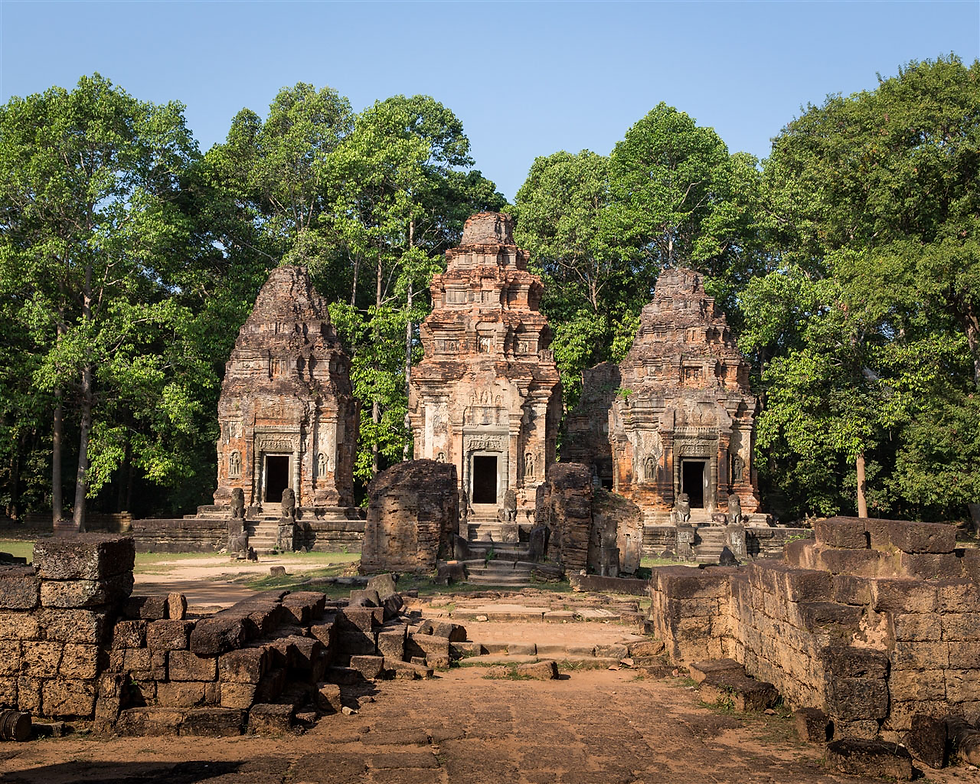
Preah Ko was the first of the three to be built, constructed by King Indravarman I around 879 CE. Its name translates to "Sacred Bull," a reference to the three statues of Nandi, the bull mount of Shiva, that stand guard in front of the temple's main shrines.
The temple consists of six brick towers arranged in two rows on a low platform. The front row is dedicated to male ancestors of the royal lineage, the rear to female. The towers are relatively modest in size, but look closely at the surface carvings and you will find extraordinary detail: devatas carved into the brick, false doors with intricate lintel work, and Sanskrit and Old Khmer inscriptions that are among the oldest surviving examples of royal Khmer epigraphy.

What strikes you at Preah Ko is the intimacy of the scale. After the sheer enormity of Angkor, these towers feel almost approachable. There is no crushing crowd, no souvenir stall every ten metres. Just old brick, birdsong, and the occasional local family who has come to make an offering at the small shrine still active within the complex. Temples like this remind you that these were never ruins to begin with. They were always, and still are, places of living faith.
Bakong: The First Temple Mountain
If Preah Ko is about intimacy, Bakong is about ambition. Built by the same king, Indravarman I, and consecrated in 881 CE, Bakong is the earliest surviving example of a Khmer temple-mountain, the architectural concept that would eventually give the world Angkor Wat.
The idea behind the temple-mountain is elegantly symbolic. Mount Meru, the sacred mountain at the centre of Hindu and Buddhist cosmology, is the dwelling place of the gods. A temple built to replicate its form becomes, in a very literal theological sense, a home for the divine on earth. And the king who builds it becomes its earthly steward.

Bakong rises in five sandstone tiers, each one smaller than the last, creating a stepped pyramid that culminates in a central prasat, or tower sanctuary, at the top. The full complex is surrounded by a moat, and the approach causeway is flanked by nagas, the serpentine figures that appear throughout Khmer sacred architecture as guardians and cosmic symbols.

Walking up Bakong is a short climb but a meaningful one. At the summit, you get a wide, unobstructed view across the surrounding flatlands, the kind of view that makes sense of why this location was chosen. The Khmer kings did not just build for beauty. They built to make a statement about where power met the sacred, and Bakong was that statement, made in stone for the first time.
The complex also includes eight smaller brick towers arranged around the central pyramid, along with two libraries and a later-added Buddhist sanctuary at the base. It is a layered site that rewards a slow, unhurried walk. Bakong is technically the largest of the three Roluos temples, but it rarely feels overcrowded. On most mornings, you will have long stretches of it to yourself.
Lolei: The Island Shrine
Lolei is the third temple of the Roluos Group, and the most atmospheric in a different way. It was built by King Yasovarman I around 893 CE, originally on an artificial island in the centre of a large reservoir (baray) called the Indratataka. The reservoir no longer holds water, so today Lolei sits on what feels like a low mound surrounded by rice paddies and a small, active Buddhist monastery.
The four brick towers of Lolei are in a more weathered state than those at Preah Ko or Bakong, with portions partially collapsed and the brick significantly eroded over twelve centuries. But the lintels that remain show some of the finest decorative carving of the early Khmer period, with intricate kala faces, floral scrollwork, and scenes from Hindu mythology still visible despite the centuries of exposure.

The active monastery beside Lolei adds a dimension the other two sites lack. Young monks in saffron robes move through the compound. Incense drifts from small shrines. The contrast between the ancient crumbling towers and this continuing daily religious life is quietly arresting. It is a reminder that for all the academic fascination with these temples as historical artefacts, they exist within a living tradition that never really stopped.
Prasat Prei Monti
Built in the late 9th century during the reign of Indravarman I, this small brick temple is among the earliest surviving structures in the Roluos Group, predating even Preah Ko. The carvings are worn, the structure partially weathered, but there’s something deeply grounding about it. You’re not looking at a monument that has been polished for visitors, you’re standing in front of something that has simply endured.
There are no crowds here, no defined pathways guiding you through. Just quiet space, scattered ruins, and the feeling of encountering Angkor before it became what the world now knows.

Why the Roluos Group of Temples Deserve a Place in Your Itinerary
This is like two sides of a coin: there is an honest practical answer and a more personal one.
The practical answer: the Roluos Group is included in the standard Angkor Archaeological Park pass, which means there is no additional entry cost. It sits just 30 to 40 minutes by tuk-tuk from central Siem Reap. It is best visited in the late afternoon when the light is warm and the temperature has dipped slightly from its midday peak. And because most visitors skip it, you will almost certainly have a more peaceful experience here than at any major site on the Small or Grand Circuit.
The more personal answer is harder to articulate but more important. The Roluos Group gives you context that Angkor Wat alone cannot. When you stand inside Angkor Wat and feel the weight of what the Khmer Empire achieved, Roluos is what lets you trace that achievement back to its roots. The proportions that seem perfected at Angkor Wat were first attempted here, in brick, over a century earlier. The temple-mountain concept that defines Khmer sacred architecture was first realised at Bakong. The devotional relationship between king, gods, and ancestors that shaped every Khmer monument was written in stone, literally, at Preah Ko.
Great architecture does not appear fully formed. It grows. It is tested, refined, reconsidered, and pushed further with each generation. The Roluos temples are the earliest chapters of that growth. They are unpolished in ways that Angkor cannot be, and that relative roughness is part of their honesty.
Planning Your Visit
The Roluos Group is best explored as a half-day trip, either on its own or combined with a quieter morning at one of the outer temples. The three main sites are spread across a few kilometres and are easy to cover by a tuk-tuk or a bike. Most drivers familiar with the Angkor circuits will know the route well.
There’s no strict order to explore the Roluos Group, but the journey tends to flow naturally. Most travellers begin at Preah Ko, move onward to Bakong, pause at the quieter Prasat Prei Monti along the way, and finish at Lolei. The sites are relatively compact, and the whole loop takes around two to three hours at an unhurried pace.
Carry water, wear comfortable shoes, and bring a little more patience than you think you need. The signage at the Roluos temples is sparser than at the main Angkor sites, and some of the pathways are uneven. But that slight roughness is part of what makes them feel so different from the polished visitor experience of the central complex.
Come here not for the spectacle but for the story. The Roluos Group is where the Khmer Empire’s dream began getting carved in stone. Everything that came after, including one of the most astonishing architectural achievements in human history, started here.


Comments