
Cambodia Trip: The Complete Travel Guide

Some destinations make you feel like you've stepped into a dream someone else had. Cambodia is that place — ancient, alive, and achingly beautiful in ways no photograph ever fully captures.
I still remember standing at the gates of Angkor Thom, sunlight washing over the stone giants, the silence so complete it felt sacred. That moment alone was worth the entire Cambodia trip. But Cambodia gave me so much more than Angkor — it gave me river dolphins at sunset, French colonial streets smelling of lemongrass, and beaches that felt like the world's best-kept secret.
If you're planning a Cambodia trip from India, this guide covers everything — from the Cambodia itinerary to the actual Cambodia trip cost, the best month to travel to Cambodia, and whether Cambodia is safe to travel. Let's go.
Is Cambodia Safe to Travel?
Let's address this first, because every traveller asks. Yes — Cambodia is safe to travel, especially in all the major tourist zones covered in this guide. Petty theft exists in crowded areas (as it does everywhere), and you should avoid isolated areas after dark. Tuk-tuk scams near temples are more annoying than dangerous. The Cambodian people are among the warmest I've encountered anywhere in Southeast Asia — genuinely hospitable, curious, and proud of their country's resilience.
One important note: Cambodia has a complex recent history with the Khmer Rouge. Traveling here with awareness and respect matters.
Best Month to Travel to Cambodia
The best month to travel to Cambodia is between November and February — cool, dry, and perfect for temple exploration without melting into the pavement. March and April get brutally hot. The wet season (May–October) brings lush green landscapes and fewer crowds, but flooding can disrupt some areas. If you're on a budget and don't mind afternoon showers, the shoulder months of October and November are a sweet spot.
Cambodia Trip Cost: What to Budget
Cambodia travel cost is remarkably kind to the budget-conscious traveller.
Budget traveller: ₹2,500 – ₹3,800/day (guesthouses, street food, shared tuk-tuks)
Mid-range traveller: ₹5,000 – ₹7,500/day (boutique hotels, sit-down meals, private transfers)
Comfort traveller: ₹8,500 – ₹12,500+/day
Cambodia trip cost from India — a return flight from major Indian cities (Mumbai, Delhi, Bangalore) to Phnom Penh or Siem Reap typically ranges from ₹18,000–₹35,000, often with a layover in Bangkok or Kuala Lumpur. Add accommodation, food, transport and a 30-day visa on arrival (USD 30 for tourist), and a solid 10-day Cambodia trip from India can be done for ₹70,000–₹1,00,000 all-inclusive from India.
The Cambodia Itinerary: Region by Region
Here's how I'd structure your Cambodia travel across the country's four distinct regions.
East Cambodia: Kratie — Where the River Dolphins Live
Most travellers skip Kratie. Don't.
This quiet riverside town in eastern Cambodia is home to the critically endangered Irrawaddy river dolphins — and watching them surface at golden hour in the Mekong is one of those travel moments that stays with you permanently. Hire a small boat, drift out in the late afternoon, and wait. The dolphins arrive like moments the river decides to share with you.

Kratie is also the perfect slow-travel antidote if you've been temple-hopping. Rent a bicycle, ride to Koh Trong island, eat fish amok at a wooden table by the river, and let the pace of the Mekong reset you.
Recommended time: 1–2 days
South Cambodia: Phnom Penh
Cambodia's capital is impossible not to love.

Top things to do in Phnom Penh:
The Royal Palace and Silver Pagoda are genuinely dazzling — the floor of the pagoda contains over 5,000 silver tiles, and the gold Buddha studded with diamonds will make your jaw drop. The National Museum holds the finest collection of Khmer art in the world. The Riverside Promenade is perfect for evening walks, with street food carts and café terraces spilling onto the path.
But Phnom Penh isn’t just vibrant—it’s deeply moving. The Tuol Sleng Genocide Museum (S-21 Prison) and the Choeung Ek Killing Fields are heavy, heartbreaking visits — and absolutely essential ones. Understanding what happened here makes everything else you see in Cambodia more meaningful.
Then let the city show you its other face — craft cocktails at a rooftop bar, excellent Khmer cuisine at Malis or Cuisine Wat Damnak's Phnom Penh outpost, and the buzz of the night markets.
Recommended time: 2 days
West Cambodia: Sihanoukville and Kampot
Sihanoukville has changed dramatically in recent years — overdeveloped and noisy in the main town — but the islands just offshore (Koh Rong, Koh Rong Samloem) remain gorgeous. Think white sand, turquoise water, and bioluminescent plankton lighting up the sea at night like scattered stars.
Kampot is the real treasure of the south. A crumbling French colonial town on a lazy river, it's famous for its pepper (Kampot pepper is genuinely among the world's finest) and its relaxed, time-forgotten atmosphere. Kayak up the river, eat a pepper crab, and stay longer than you planned.
Recommended time: 2–3 days
North Cambodia: Siem Reap, Battambang and Tonle Sap
Siem Reap is the gateway to Angkor and a town that has built an entire identity around its extraordinary ancient neighbour. The old market area has great restaurants, night markets, and the famous Pub Street (lively, not necessarily sophisticated — but fun for a night).
Before the temples absorb you completely, consider a morning on Tonle Sap Lake — Southeast Asia's largest freshwater lake, whose waters rise dramatically each monsoon season, flooding the surrounding forest. Floating villages, stilted houses, and a vast aquatic ecosystem make this one of the most surreal landscapes I've seen anywhere.
Battambang, a couple of hours west, rewards the curious traveller with Khmer colonial architecture, a thriving arts scene, and the legendary Bamboo Train — a bamboo platform on wheels that rattles through the countryside at alarming speed.
Recommended time: 3–4 days for the whole northern region

The Angkor Temple Complex: Understanding the Circuits
Now. The temples.
The Angkor Archaeological Park is not one temple — it's a vast complex spread across roughly 400 square kilometres. It's organized into circuits to make sense of the scale.
The Small Circuit covers the core highlights: Angkor Wat, Angkor Thom (with Bayon, Baphuon, and the Elephant Terrace), and Ta Prohm. A full, unhurried day.

The Grand Circuit extends to more remote temples — Preah Khan, Neak Pean, and Ta Som — beautiful and far less crowded.
Roluos Group, located about 13 km from Siem Reap, is often skipped but genuinely wonderful — these are among the oldest temples of the Khmer Empire, predating Angkor Wat by over three centuries. Preah Ko, Bakong, and Lolei sit in quiet countryside, worn by time, largely unrestored, and deeply atmospheric.
Angkor Wat: Go at Sunrise
You've seen the photographs. The reflection of the five towers in the long pool at dawn, the sky shifting from black to indigo to gold. Here's the thing — it's even better in person.
Arrive by 5:15 AM. Find your spot at the reflecting pool. Watch the light change. Don't talk much. The scale of Angkor Wat — built in the 12th century, dedicated to Vishnu, stretching 200 hectares — only fully lands when you're standing inside it. The bas-reliefs alone (depicting the Mahabharata, the Ramayana, and the Churning of the Ocean of Milk) would keep you lost in its stories for hours.


Angkor Thom and Bayon: The City of Faces
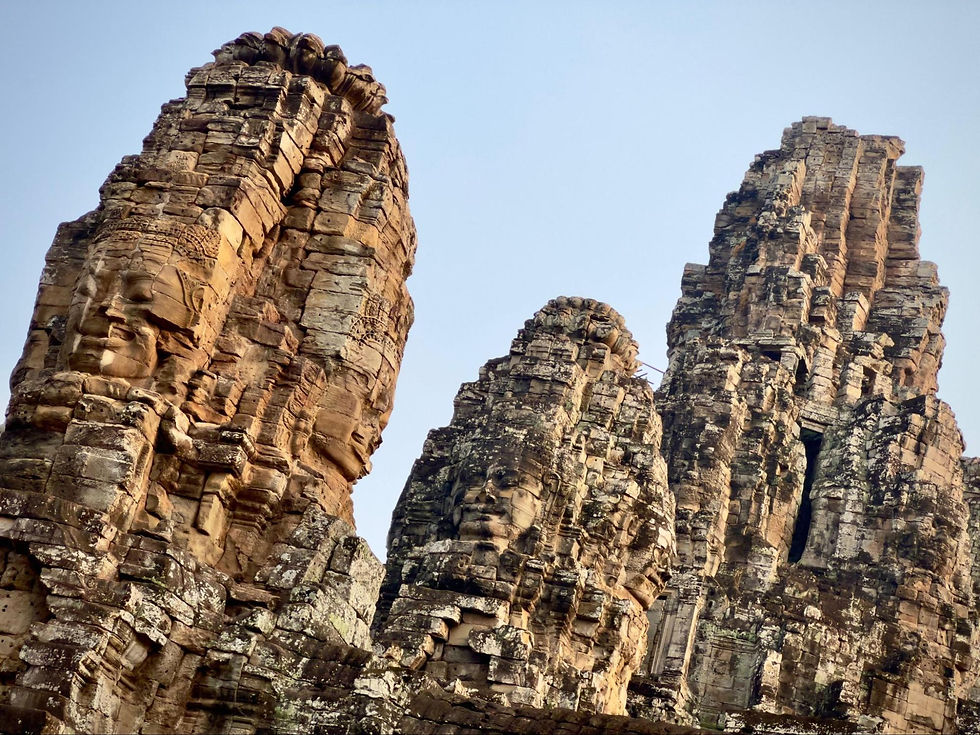
Angkor Thom was once a functioning city of nearly a million people. Walking through the South Gate — flanked by 54 gods on one side, 54 demons on the other, locked in cosmic tug-of-war — you feel the theatre of empire immediately.
Inside, Bayon Temple is one of the most extraordinary things I have ever seen. Fifty-four towers, each carved with four gigantic serene faces gazing in all directions. Over 200 faces in total. Every angle you turn, you're being watched — calmly, immovably, with the faint trace of a smile that Khmer sculptors somehow perfected. Come in the morning light when the stone turns golden.
Ta Prohm and the Jungle Temples: Where Nature Wins
Ta Prohm is where the jungle fought back and nobody stopped it.
Massive silk-cotton and strangler fig trees have grown directly through and over the temple walls — roots as thick as houses splitting stone, branches draping over galleries like protective arms. It's the most viscerally alive of all the temples. Yes it’s the one made famous by the Tomb Raider series. Arrive right when the gates open, before the tour groups descend so that you can have the experience all by yourself.
Nearby, Preah Khan and Ta Som offer the same jungle drama with a fraction of the visitors. Walk slowly. Let the silence accumulate.
Final Thought
Cambodia will ask something of you—your patience, your strength, your willingness to feel more than you planned to. It doesn’t try to impress you; it stays with you. In its temples, its silences, its people, you begin to see a country shaped by both beauty and endurance. And at sunset on the Mekong, the dolphins rise—brief, quiet, almost unreal—like Cambodia itself, something you feel far more deeply than you can ever explain.


Comments